
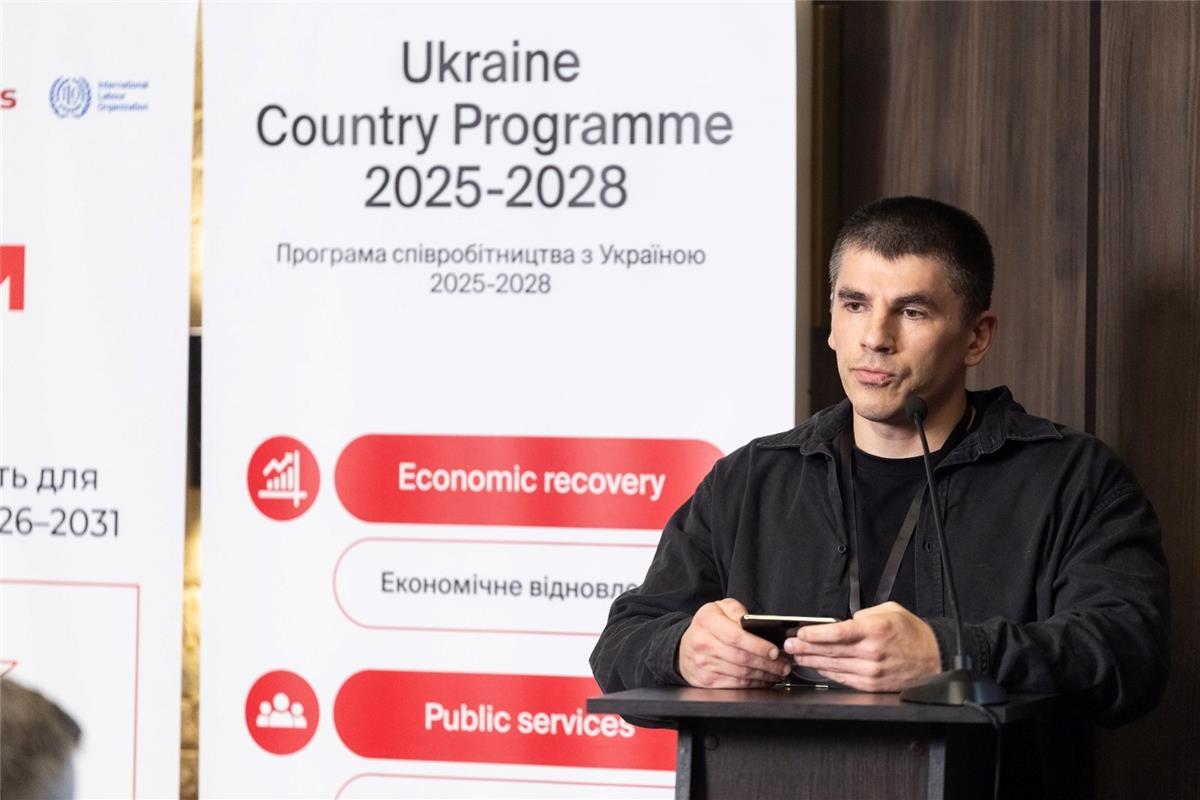
On 4 November 2026, the CORE Program: Competitiveness for Recovery Ukraine 2026–2031 was presented in Kyiv.
Over five years, Switzerland will invest CHF 30 million in a competitive, innovation-driven, inclusive and resilient private sector that contributes to job creation, Ukraine’s recovery and closer integration with the EU. The Program is implemented by a consortium of Helvetas and NIRAS, in collaboration with the International Labour Organization (ILO) in Ukraine, with the support of Switzerland through the Swiss State Secretariat for Economic Affairs (SECO).
“Competitiveness for Ukrainian producers means the opportunity to become part of European and global value chains and, ultimately, to build stronger economic ties with Swiss markets. CORE will therefore direct most of its resources towards improving conditions for doing business, providing practical tools that help the government guide economic development, and enabling businesses to identify new paths to growth amid the challenges of war,” said Ambassador Pietro Lazzeri, Head of Economic Cooperation and Development, SECO.
Switzerland works on two tracks at once: urgent repairs to infrastructure, and the long-term strength of the economy. It already supports key parts of Ukraine’s economic base — export promotion, SME financing, business associations, eco-industrial parks and quality standards. CORE builds on this work, so that Ukrainian companies, sectors and institutions become competitive enough to hold their ground at home and to join European and global value chains.
The Program was planned jointly by Switzerland and the Ministry of Economy and Environment, and the memorandum was signed in Davos in January 2026. CORE is Ukrainian-owned: the Ministry co-chairs its Program Steering Committee together with SECO and the Embassy of Switzerland, and projects are designed and delivered by Ukrainian organisations and enterprises, which receive most of the Program’s resources as grants.
“The Government’s priorities are to lower investment risk, prepare investment-ready projects, cut regulatory barriers, align rules with the EU, and add more value inside the country. Ukrainian business continues to work despite attacks on energy, logistics and industrial infrastructure, and companies that keep producing and exporting are the basis of recovery. Under CORE, reforms are prepared together with the Ministry’s departments,” said Oleksandr Tsybort, Deputy Minister of Economy of Ukraine for Digital Development, Digital Transformations, and Digitalization.
“The CORE Program is built so that the projects we support match the needs and priorities of the government, the regions, sectoral associations and business: their representatives will sit on the Program’s governing bodies. Calls for grants involve prior consultation with stakeholders and potential applicants. Components I–IV support projects with long-term effect and substantial results for business organisations and Ukrainian enterprises,” said Valeriy Dobrovolski, Head of the CORE Program.
How the Program works
Component I works with national and regional bodies on better policies, regulations and public–private dialogue: implementation of key government strategies, business- and investor-friendly regulations and instruments, and public–private dialogue platforms.
Component II strengthens the competitiveness of priority sectors and their value chains at regional and national levels, supporting their integration into European and global value chains; it works with business associations, regional development agencies, cluster initiatives and other business support organisations.
Component III provides co-investment grants for the modernisation of small and medium-sized enterprises that play a leading role in their value chains and can help raise competitiveness across their sectors.
Component IV, led by the ILO, builds Productivity Ecosystems for Decent Work: labour policy and social dialogue aligned with ILO and EU standards, sector capacity and advocacy, and workplace skills, safety and management practices. The Helvetas–NIRAS consortium implements Components I–III and the Strategic Advice Window; the ILO implements Component IV, and the two coordinate their work across all four.
Alongside the grants, the Strategic Advice Window operates in two parts: the Quick Support Mechanism for the Ministry of Economy and Environment, and access for SMEs, associations and public institutions to Swiss and international expertise, from a country that has ranked first in the Global Innovation Index for the sixteenth year running.
“Ukraine’s current needs and future economic recovery depend on businesses being able to grow, innovate and create quality jobs. Through CORE, the ILO supports greater competitiveness through SME productivity and decent work. ILO works with government, employers’ and workers’ organisations at different levels to deliver a better business environment, a more inclusive labour market and companies that can be sustainable and able to create quality employment so economic growth delivers tangible benefits for everyone across Ukraine,” said David Marcos, Project Manager, ILO Country Office for Ukraine.
About
The CORE Program: Competitiveness for Recovery Ukraine 2026–2031 is an economic development programme with a budget of CHF 30 million, approved by the Federal Council in September 2025. It is part of a larger commitment: CHF 5 billion planned for Ukraine up to 2036, including CHF 1.5 billion for 2025–2028 — the largest country programme in the history of Swiss development cooperation.
The launch event was opened by Ambassador Jacques Gerber, Federal Council Delegate for Ukraine; Ambassador Pietro Lazzeri, Head of Economic Cooperation and Development, SECO; Oleksandr Tsybort, Deputy Minister of Economy of Ukraine for Digital Development, Digital Transformations, and Digitalization; Thomas Mauget, Ukraine Coordinator, Helvetas, representing the Helvetas–NIRAS consortium; and Aida Lindmeier, Director of the ILO Country Office for Ukraine. The Program was presented by Valeriy Dobrovolski, Head of the CORE Program, and David Marcos, Project Manager, ILO Country Office for Ukraine.
CORE Program social media: LinkedIn, Facebook, Instagram